
For many enterprises, the journey toward on-premises AI begins with the GPU—and rightly so. GPU performance determines which models can be deployed, how quickly they respond, and how many users or applications the system can support.
Once the first model is running, however, the conversation quickly expands beyond compute. Enterprises must connect the model with internal knowledge, keep that knowledge current, support more users and applications, and protect the growing volume of models, embeddings, indexes, and processed data.
This is where an AI project begins to become an enterprise platform—and where the AI Data Foundation starts to determine whether it can grow sustainably.
Enterprise AI Has a Different Destination
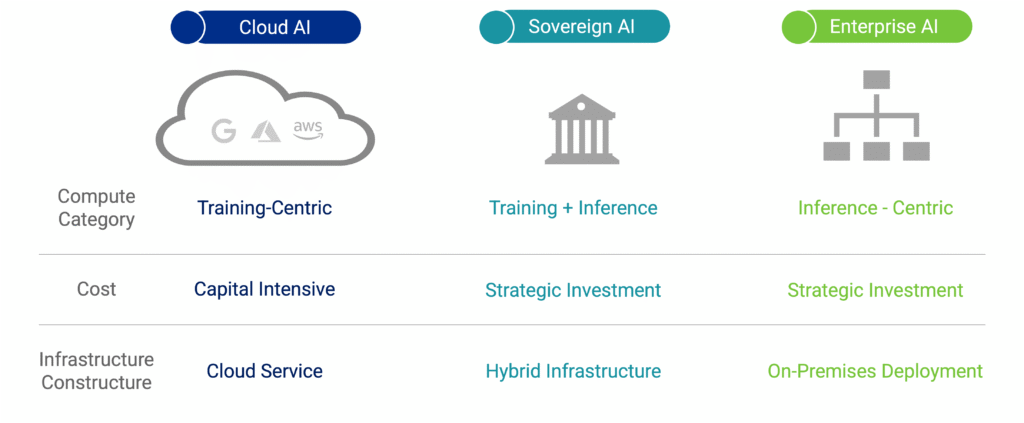
The most visible AI infrastructures today are built by hyperscale providers. They use massive GPU clusters and enormous datasets to train foundation models and operate global AI services.
Most enterprises have a different objective.
Rather than training a large language model from the ground up, they are more likely to deploy a pre-trained open-source or commercial LLM within a controlled environment and connect it with proprietary information such as product documentation, technical knowledge, internal policies, research, and operational procedures.
The goal is not to recreate a smaller hyperscale data center. It is to build a right-sized environment that transforms existing models and enterprise data into practical applications, including internal assistants, document intelligence, knowledge management, customer support, and industry-specific workflows.
RAG also changes the relationship between AI and data. An enterprise knowledge base is not prepared once and left untouched. Documents are continuously created and revised, while content must be collected, processed, enriched with metadata, converted into embeddings, and indexed for retrieval.
As adoption grows, more applications may share the same knowledge base, more users may access the service, and additional models may be introduced. The system must continuously access source documents, vector indexes, model files, and application data.
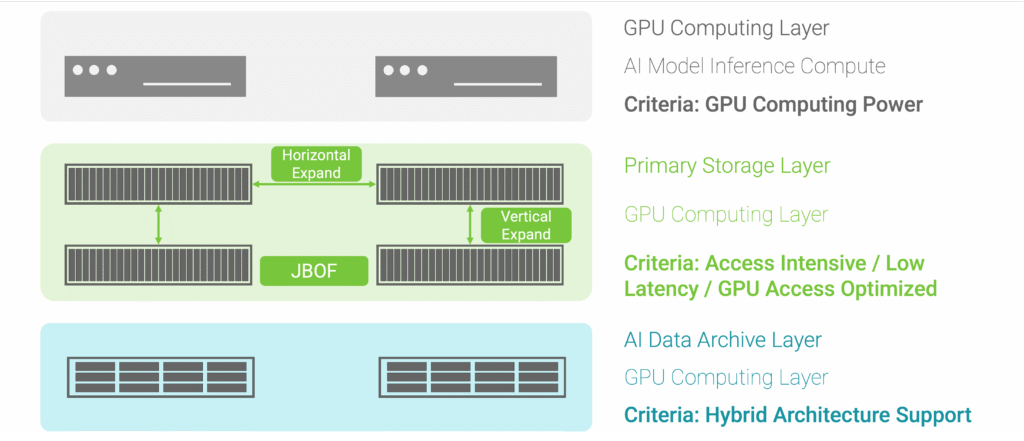
Storage is therefore no longer simply where information is kept. It becomes an active part of the AI workflow: the GPU executes the model, while the AI Data Layer supplies the enterprise knowledge that makes the model useful.
From PoC to a Production-Ready AI Data Layer
A proof of concept can often run on a single GPU server with locally attached storage and a limited dataset. As AI moves into production, however, more GPU servers, applications, development teams, and enterprise data sources must work together. Isolated storage can quickly lead to duplicated data, fragmented management, and limited scalability.
A production-ready AI Data Layer should provide a shared and consolidated foundation for models, enterprise data, indexes, application outputs, and RAG development. Support for access methods such as NFS and S3-compatible object storage allows different AI tools and data sources to connect through the protocol best suited to each workload.
As inference services support larger models, more applications, and growing numbers of concurrent users, the data layer must deliver consistent bandwidth and low-latency access to model files, indexes, and supporting data. This helps maintain responsive inference while allowing GPU resources to remain focused on model execution.
The same architecture must protect AI data assets throughout their lifecycle. Active models, datasets, indexes, and inference data can remain on the high-performance tier, while retired model versions, completed projects, historical embeddings, and less frequently accessed assets move seamlessly to a more cost-efficient archive layer.
A shared and consolidated architecture is also essential for future growth. Instead of adding isolated storage whenever a new GPU server, AI application, or department is introduced, enterprises should expand from a common data foundation. This allows models, datasets, and AI data assets to remain accessible across the environment while reducing duplication, simplifying management, and maintaining consistent protection.
Scalability must therefore be planned as a core requirement rather than a future upgrade. As GPU resources, model sizes, concurrent inference workloads, and enterprise data volumes increase, the high-performance tier must scale horizontally in bandwidth, throughput, and capacity. By combining shared access, consolidated management, integrated archive, and demand-driven expansion, the AI Data Layer can grow with the entire on-premises AI infrastructure without disruptive migration or repeated architectural redesign.
Preserving the Value Created by AI
Within the broader AI infrastructure, the AI Data Layer serves as the foundation for managing and preserving enterprise AI assets. It is not an optional extension, but a necessary investment that supports data accessibility, performance, protection, and long-term reuse. To maximize the value of enterprise AI, organizations must also plan deployment scale carefully, balancing current workload requirements with future growth, operational efficiency, and cost. A well-designed AI Data Layer enables enterprises to build an AI environment that is not only effective today, but also sustainable as data, models, and business demands continue to evolve.