
A leading Eastern European data center and IT infrastructure service provider specializing in colocation, managed hosting, and enterprise communications services. The company operates multiple high-performance data centers and delivers mission-critical infrastructure solutions, including server hosting, network connectivity, fiber optic communications, and IT equipment leasing for enterprise customers across industries such as finance, telecommunications, and digital services.
With a strong focus on reliability, scalability, and information security, the company provides secure and resilient infrastructure environments designed to support business-critical applications, virtualization platforms, and large-scale data processing workloads.
As demand for virtualization and managed infrastructure services continued to grow, the company needed to support increasing VM density, expanding storage capacity, and higher customer expectations for service availability.
The organization managed a large-scale virtualized environment supporting enterprise applications, internal business systems, databases, and customer-facing services across multiple data centers. With hundreds of servers and storage systems operating simultaneously, maintaining stable performance and operational efficiency became increasingly challenging.
At the same time, traditional enterprise virtualization licensing models and ongoing infrastructure expansion costs were placing growing pressure on the IT budget. The company also faced challenges related to storage utilization efficiency, future capacity planning, and maintaining stable operations during peak workload periods.
As more customers relied on the company’s infrastructure for business-critical workloads, the IT team needed a more flexible and scalable virtualization architecture that could support long-term business growth without significantly increasing operational complexity and infrastructure investment.
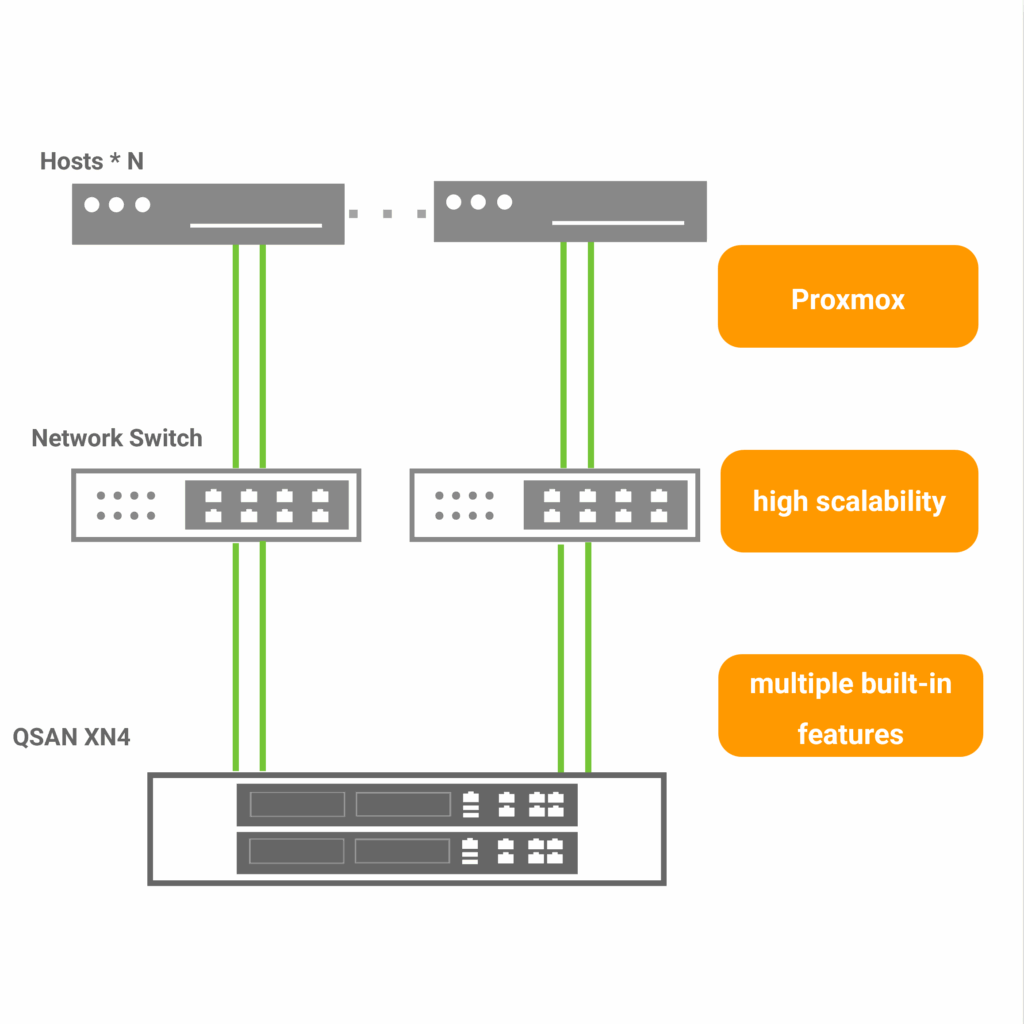
To address these challenges, the company deployed a cost-efficient virtualization infrastructure built on Proxmox VE and QSAN unified storage solutions.
By combining open-source virtualization technology with enterprise-grade shared storage, the organization was able to significantly reduce dependence on high-cost virtualization licensing while still maintaining the centralized management, scalability, and high-availability capabilities required in modern data center environments.
QSAN storage provided stable performance for VM workloads, flexible storage expansion, and simplified resource management across the virtualized environment. Features such as Thin Provisioning, Snapshot protection, and high-availability support also helped improve storage utilization and reduce day-to-day operational overhead for the IT team.
The new infrastructure architecture enabled the company to scale resources more efficiently as customer demand increased, while ensuring stable service delivery for mission-critical applications and optimizing long-term infrastructure investment.
By adopting a storage solution optimized for open-source virtualization platforms such as Proxmox, the organization significantly reduced reliance on high-cost enterprise virtualization software.
Combined with Thin Provisioning and data reduction technologies, the company improved storage utilization efficiency while lowering overall infrastructure and storage management costs — all without compromising enterprise-grade performance and reliability.
With a high-performance architecture and high-availability design, the company achieved more stable and efficient virtualization operations across its data center environment.
The scalable infrastructure also enabled the organization to expand resources more flexibly as business demand continued to grow, while maintaining consistent system performance and uninterrupted service availability for critical workloads.
We’re here to help you find the best, most cost‑effective solution for your business.